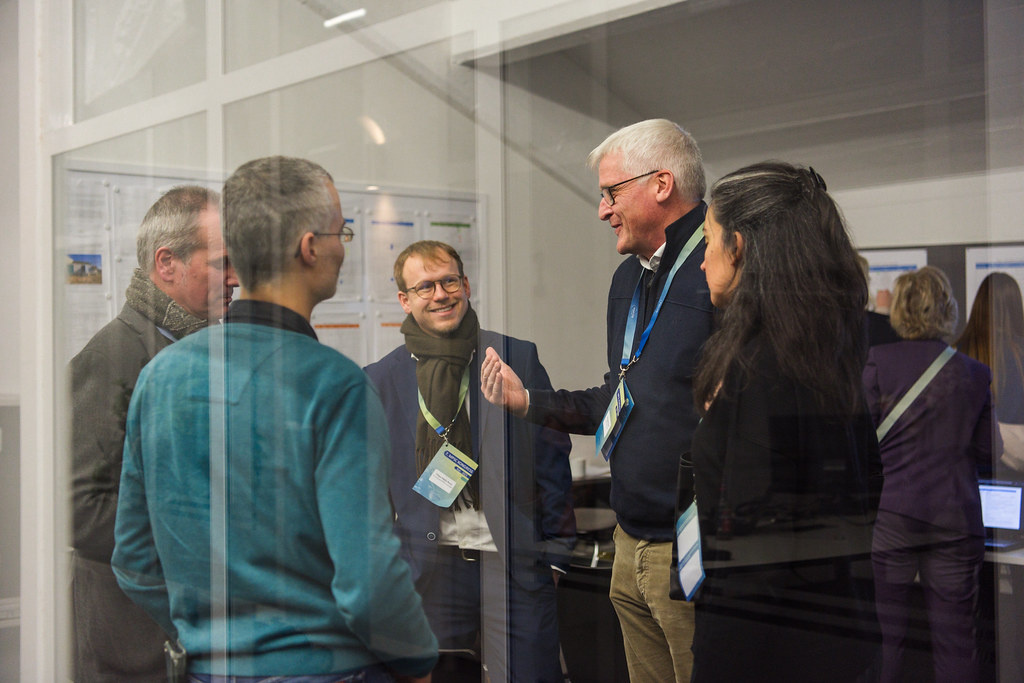
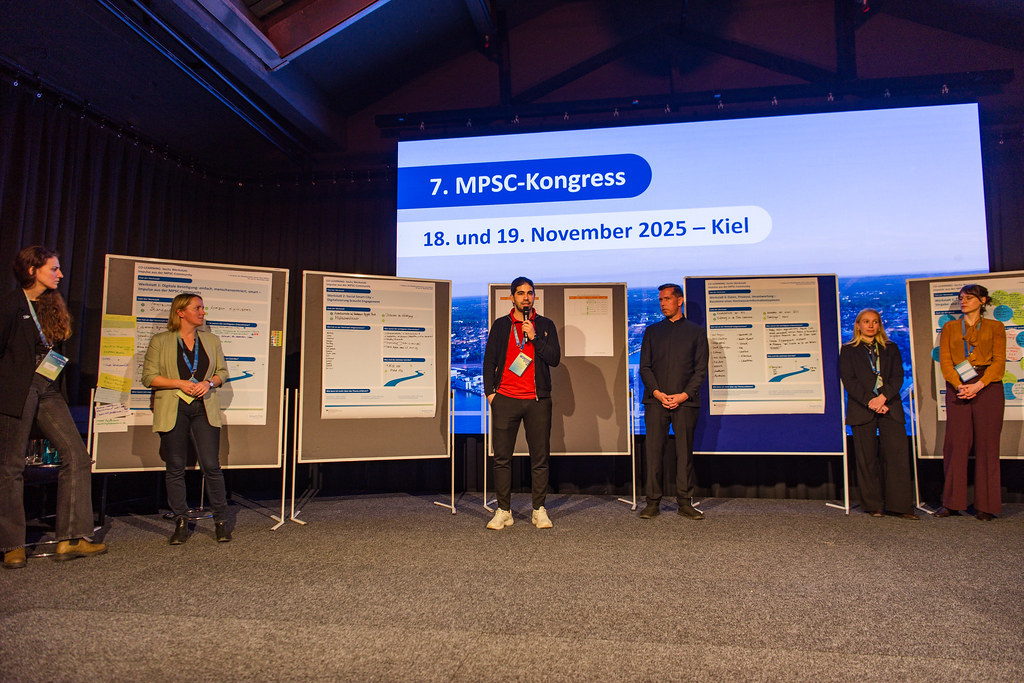
Around 200 people from municipalities involved in the model project Smart Cities came together for the 7th MPSC Congress in Kiel. Two of the Dresden projects presented their concepts in themed workshops and showed how partner municipalities can benefit from them.
"Stadt - Land - Schluss mit Piloten: Smart City erfolgreich verstetigen" was the motto of the congress: a review of the experiences of the past years and at the same time, looking to the future, the question of how the transition from funding to regular operation can be organized. The team from the Coordination and Transfer Office for Model Projects Smart Cities (KTS), for example, reported on the support services that have had a lasting impact. Representatives of municipalities from previous funding periods, such as Wolfsburg, Mönchengladbach and Bamberg, shared strategies and lessons learned from their pilot projects.
In the workshops, participants met to exchange ideas on related topics in order to receive practical support or learn about models that can be replicated for their own municipality.
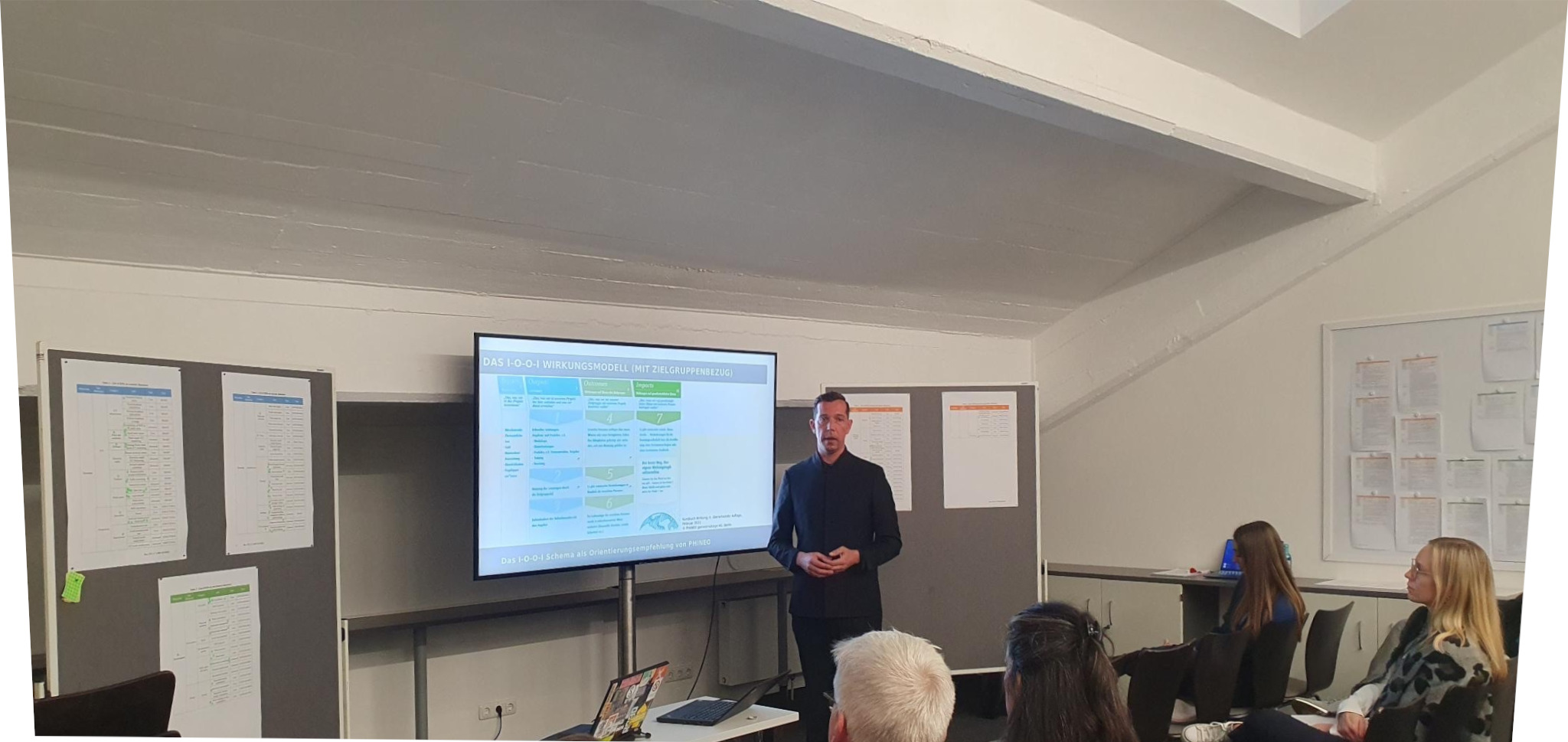
Dresden presented a model for impact analysis
Dr. Paul Stadelhofer and Nadine Reinhardt (WISSENSARCHITEKTUR - Laboratory of Knowledge Architecture, TU Dresden), who work for the Smart City Research of the model project Smart City Dresden , contributed a much-noticed impulse. They presented their model for impact analysis, with which the "Input - Output - Outcome - Impact" scheme can be applied to the planning, management and evaluation of a Smart-City measure in a differentiated but manageable way with digital support. For the indicators, Dr. Stadelhofer has systematized standards and norms from guideline documents such as ISO 4907 or the CEN Workshop Agreement. This allows measures to be aligned with consensus-based standardized objectives. In an interactive exercise, participants were able to define their own objectives and priorities using the indicator lists. The model met with great interest. Colleagues were particularly impressed by the synergy effects of using existing standards.
Data silos and development of environmental monitoring in Dresden
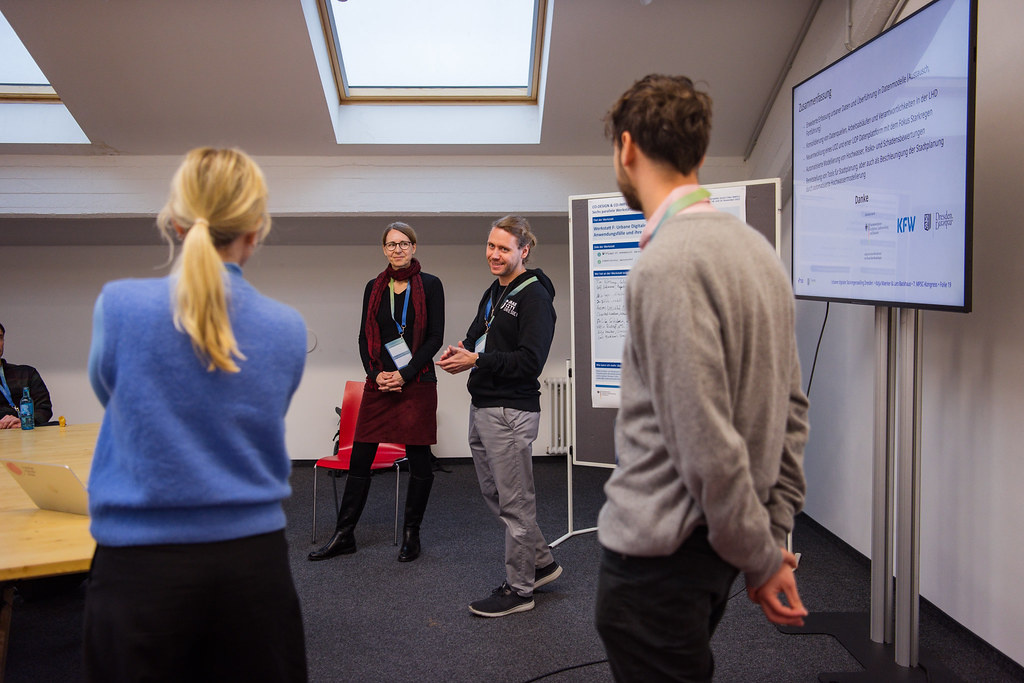
Dr. Katja Maerker (Environmental Agency Dresden) and Lars Backhaus (Institute of Hydraulic Engineering and Technical Hydromechanics, TU Dresden) gave a keynote speech in the workshop "Urban digital twins - use cases and their data models".
Dr. Maerker showed from an administrative point of view how data silos in the areas of traffic, building, sewer network and tree data can be merged in Dresden and workflows developed to keep them running. Lars Backhaus, developer of the digital twin for an environmental monitoring platform, reported on how the data from the municipal geodata infrastructure is automatically transferred, processed hydrologically and hydrodynamically and ultimately used to generate simulation models on an ad-hoc basis.
Both teams were delighted with the broad response to their projects and used the congress for a lively exchange and networking activities.
More information on the 7th MPSC Congress can be found on the website of the funding project.